
Getting started
How phpz works
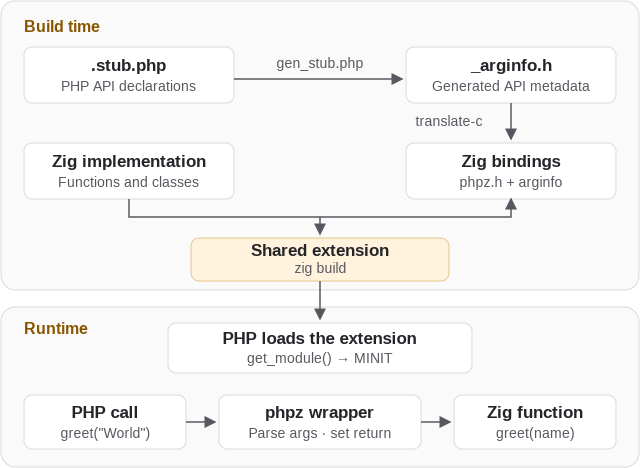
phpz compiles Zig code into a shared extension that PHP can load. Consider greet("World"). A PHP stub declares its signature, phpz binds the declaration to a Zig implementation at compile time, and PHP calls the resulting handler at runtime.
Generating API metadata from the stub
Declare function greet(string $name): string {} in the .stub.php file. When you run zig build gen-stub, gen_stub.php reads the declaration and generates _arginfo.h.
| Generated item | Purpose |
|---|---|
arginfo_greet | Describes parameter names, types and the return type for PHP argument handling and reflection |
ext_functions | Maps the PHP name greet to the handler zif_greet and its arginfo_greet metadata |
| Registration functions | Register any classes or module symbols declared in the stub |
After changing the PHP API, run zig build gen-stub before zig build. A regular build reads the existing header and checks by default that it matches the stub. Changes confined to a Zig function body need only a regular build. See Update workflow.
Binding declarations to the Zig implementation
The extension’s C header includes phpz.h and the generated _arginfo.h. The build script calls Phpz.init() to translate these C declarations into Zig bindings using translate-c. phpz then matches the implementations to their declarations at compile time.
| Zig declaration | Build result |
|---|---|
phpz.functions(functions, .{}) | Checks the Zend function table and exports PHP-callable wrappers, including zif_greet for functions.greet |
phpz.Class("Counter", Counter, .{}) | Binds the class and its methods and exports zim_* method wrappers |
phpz.module(...) | Creates the module entry and exports get_module() for the shared extension |
For typed handlers, phpz checks parameter counts, variadic flags and by-reference flags at compile time. It parses the supplied values at runtime. See Handler signatures for the binding rules. The build script calls addExtension() to compile and link the shared extension.
Loading the module and calling a handler
When loading the library, PHP calls get_module() to retrieve the module entry and install its function table. During module initialization (MINIT), phpz registers the declared symbols, INI entries, resource types, classes and observers, then runs the configured module_startup_fn. See Registration order for dependency ordering and temporary modules.
When PHP executes greet("World"), it looks up zif_greet in the function table.
- The wrapper parses the argument according to the Zig signature and passes
"World"tofunctions.greet(name)as a[]const u8. - The Zig function returns a Zend string containing
Hello, World!. - The wrapper stores that string in the PHP return value. The caller receives a PHP string.
Instance methods follow the same path. For a class with per-object Zig data, the wrapper also retrieves that instance and passes it as self.